1
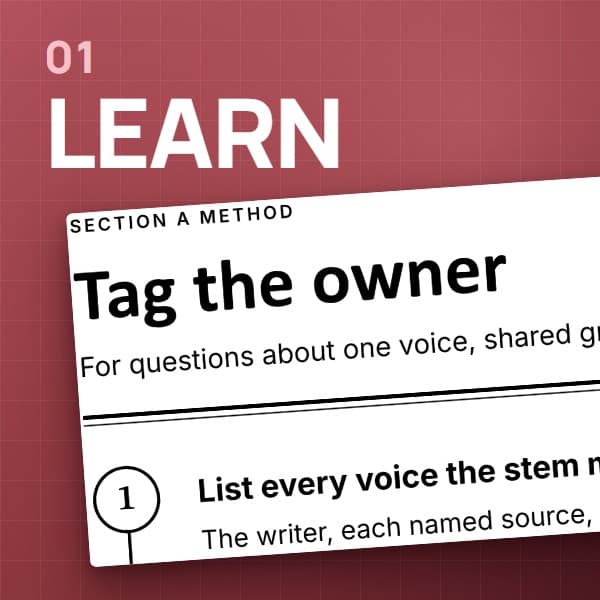
Learn the method
The 42 Section A questions sort into seven families by what they ask you to do. Each family has its own chapter, its own step-by-step method and the wrong options it is built around.


LNAT 42 Blueprint is 558 pages of teaching, practice and worked reasoning: 147 real passages, 469 four-option questions, four full mock tests, and a course in both sections of the test.
Paperback. Price, delivery and returns are set by Amazon.
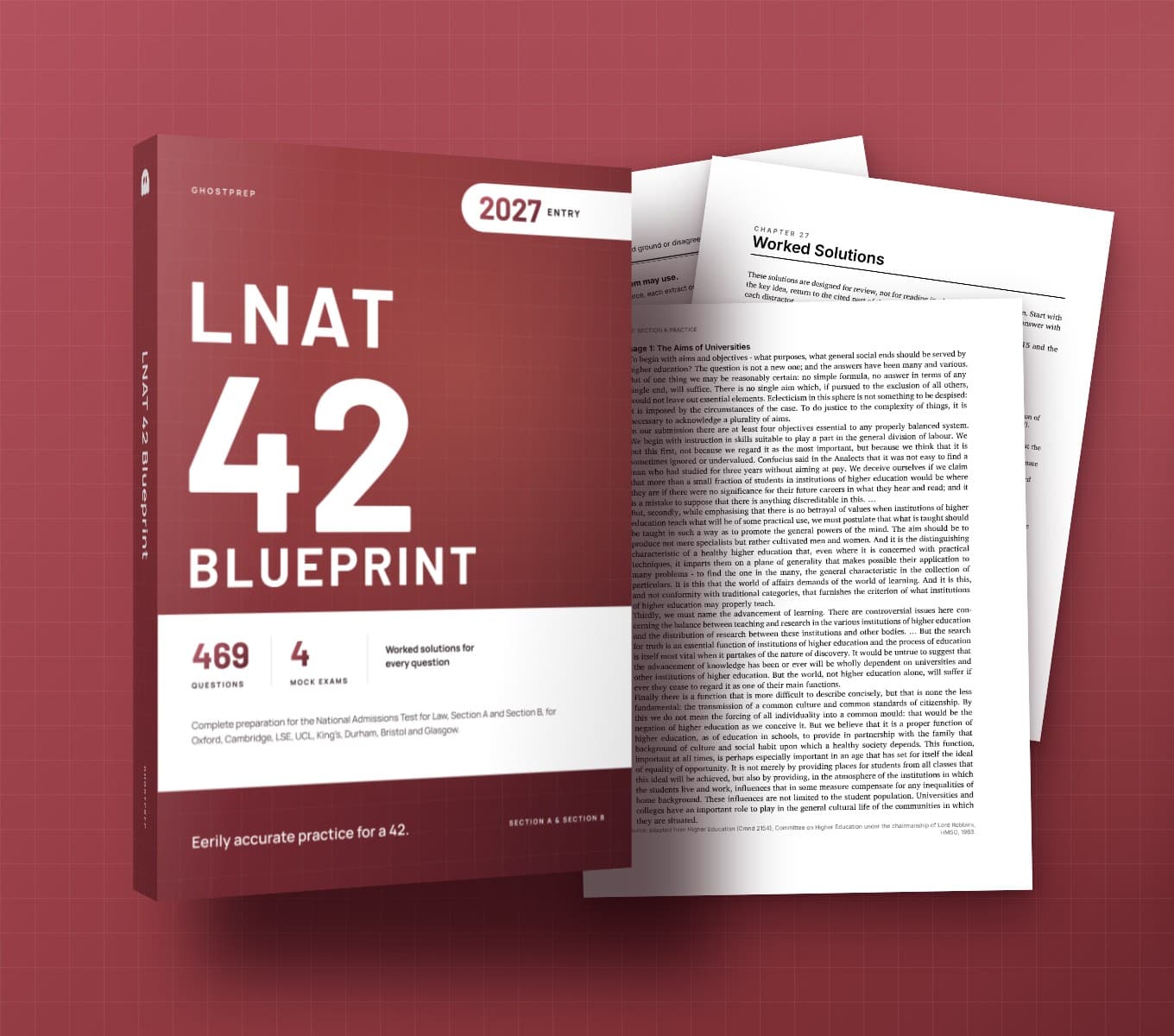
The LNAT is 42 questions on twelve argued passages in 95 minutes, then an essay in 40. The official practice material is good and there is not much of it: two practice papers, a preparation guide and one online sample test, and the two papers still give five options where the live test now gives four.
Every passage in the book is real published writing, printed with its title and source as on the test, and every question has four options, as the live test does. Practice that looks like the day is practice that carries over to it.
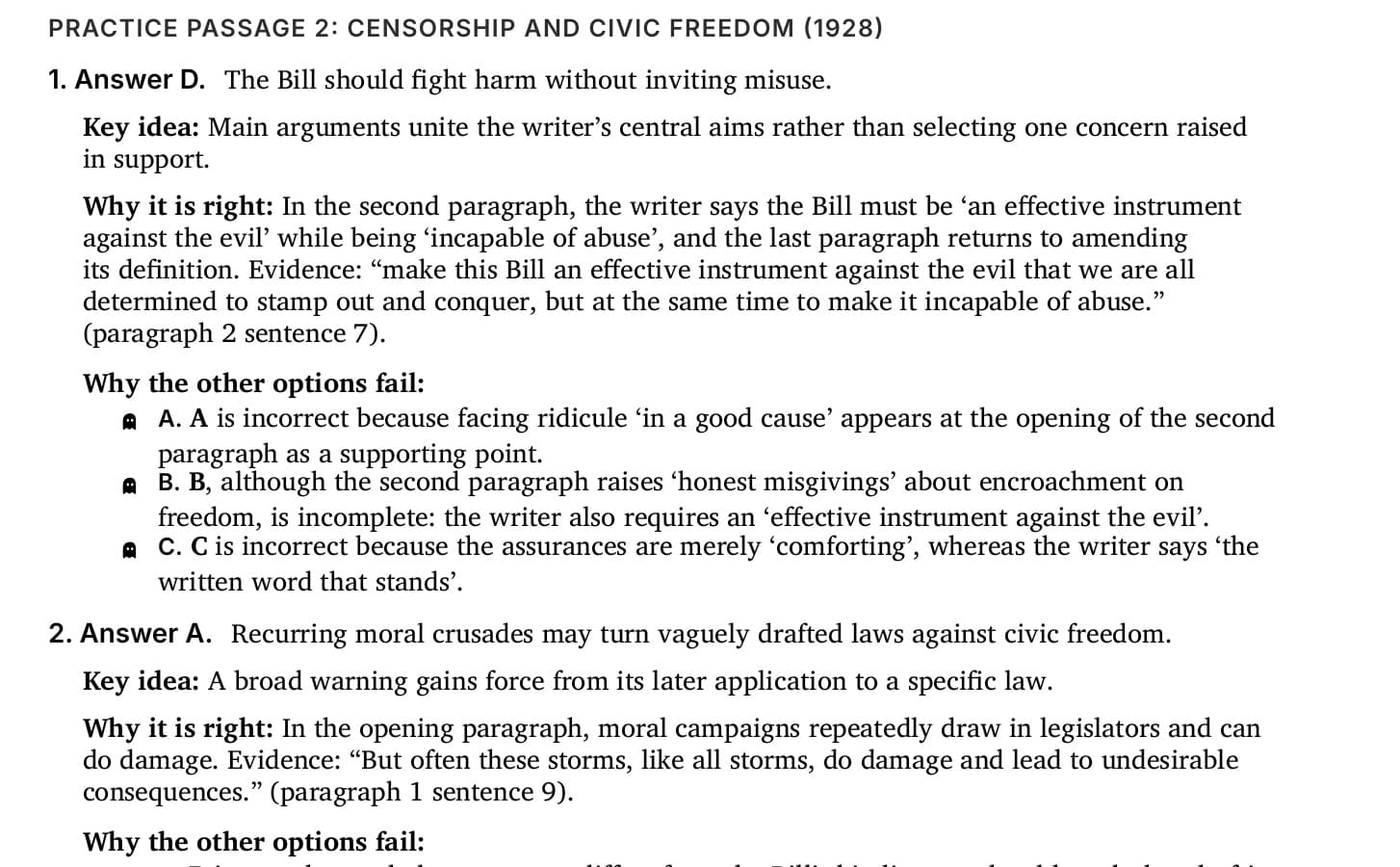
An answer key tells you that you were wrong. Every practice and mock question here is worked through: the key idea, the evidence in the passage, and why each wrong option fails.
Section B is read by the universities you apply to. The book teaches it to the qualities Oxford and Cambridge say they assess, from their published Freedom of Information replies.
Four stages, in the order you would work through them. If you are new to the test, start with the 14-question diagnostic: it points you to the chapters you need first.
The 42 Section A questions sort into seven families by what they ask you to do. Each family has its own chapter, its own step-by-step method and the wrong options it is built around.
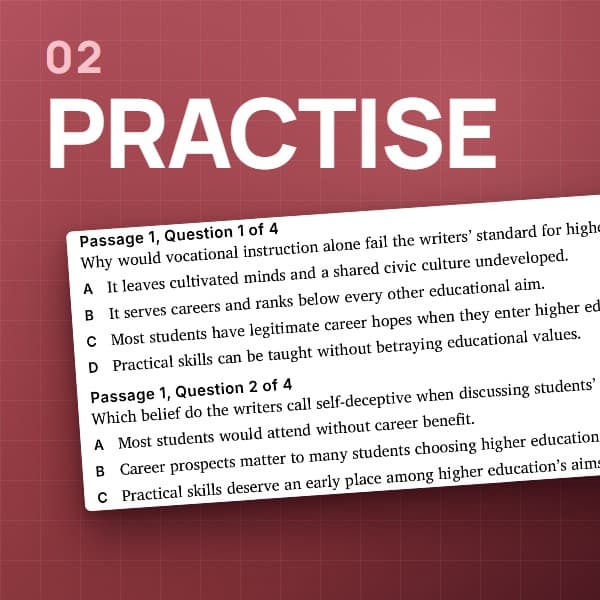
72 practice passages and 256 questions, mixed across the seven families in proportions close to the real test.
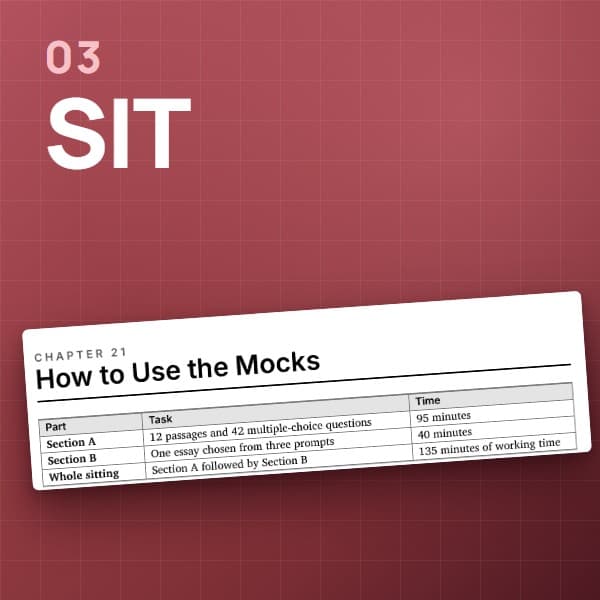
Four full mock tests with the structure of the live test: 12 passages and 42 questions in 95 minutes, then a choice of three essay prompts in 40.
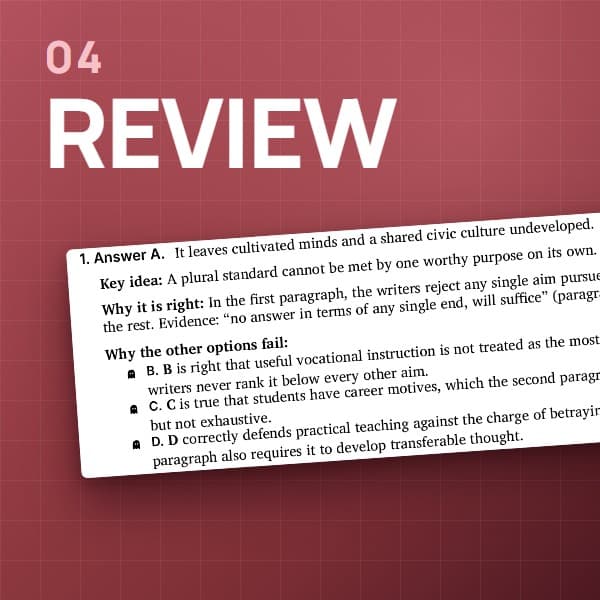
424 worked solutions, answer keys, and a one-page reference for each family's method, so every mistake turns into the next thing to work on.
An answer key tells you that you were wrong. A worked solution tells you where the reading went wrong, which is the part that changes what you do next time.
All 424 practice and mock questions are worked in full in chapter 27: the key idea, why the right answer is right with the evidence quoted from the passage, and why each wrong option fails on its own terms.
Chapter 18 answers four prompts at three levels, marks every sentence, and explains what lifts each one into the next band. Chapter 19 adds eight model essays, each beside the plan that produced it.
No clear answer yet.
Red and amber through most of it: points are raised, and none of them settles the question.
A clear answer, thinly argued.
All three colours: the answer is there, with too little reasoning behind it.
Two reasons, the best objection met.
Green through most of it, with amber where a reason could be pushed further.
A distinction that settles it.
Green almost throughout: one distinction carries the argument and answers the objection.
The bands follow the qualities Oxford and Cambridge assess, from their published Freedom of Information replies. Plus a six-line plan for writing in 40 minutes, 72 practice prompts and a self-marking guide. The GhostPrep LNAT platform marks practice essays in the same four bands.
Written to be worked through from the first page to the last, and laid out well enough to dip into if you would rather not.
Which universities use the LNAT, what a score means from university Freedom of Information data, the screen you will sit it on, and a 14-question diagnostic. Then one chapter for each of the seven question families, each with a named method and worked passages.
72 real passages and 256 questions, mixed across the seven families, with numbered paragraphs so every solution can point you to the line that settles it.
How the universities read the essay, choosing a prompt and planning in six lines, what separates a strong essay from a weak one, eight model essays beside their plans, and 72 practice prompts with a self-marking guide.
Each with the structure of the live test: 12 passages and 42 questions in 95 minutes, then a choice of three essay prompts in 40 minutes.
Answer keys, 424 worked solutions, a coverage table, a one-page reference for each family's method, and the source and licence of every passage in the book.
Some people think better with a book open and a pen in their hand. Some need the clock running and the real test screen in front of them. Most end up wanting a bit of each, which is why these are built to sit alongside one another.
Better when you are learning the methods and want to work at your own pace.
Better when you know the methods and need volume, timing and the real conditions.
Every page of the book carries the platform's address. You do not need to buy anything to start: the free account is free either way.
A real passage and three questions, marked as you go. The worked solution, the reasoning that actually teaches you something, is what the book gives you 424 of, and what a free account opens up here.
A real, shortened passage with three questions from the bank to give you a flavour of the real thing.
Between Law and Liberty - Shortened
We believe that the general public, even if they are unfamiliar with the statutory and administrative detail, accept the need for enforcement of the drugs law. Some witnesses took the view that this difficult and disagreeable work had led to a general deterioration in relations between public and police. We accept that among some young people, not all of them with an interest in drugs, it has given rise to hard feelings. That, most of us think, argues not for any fundamental change in this essential branch of law enforcement, but for examining very closely its detailed application where there may be scope for malpractices which could give rise to a genuine sense of injustice.
It is helpful to understand the background against which this sense of injustice may arise. For a variety of reasons young people resent or distrust police activities, however well-intentioned towards their welfare. Existing drugs law in the United Kingdom, as in most other countries, is based on control of availability and restriction of supply and possession without authority. Thus the young person in possession of illicit drugs remains vulnerable to police action for much longer periods than if he were committing criminal offences of the more conventional kinds. He may also imperil friends or associates who in a raid may be found near his illegal drugs. This widens the scope for suspicion. Conversely, it makes it more necessary that the police should be fair and be seen to be fair. Many young people, according to some evidence before us, suppose that the police are too easily moved to suspect them of being drug offenders from their appearance, such as long hair and unconventional dress. What justifies “reasonable” suspicion has been a major issue in our discussions.
Adapted from Powers of Arrest and Search in Relation to Drug Offences, Advisory Committee on Drug Dependence (Home Office), HMSO, 1970.
In answering critics of drug enforcement, the writer mainly argues that:
The LNAT is sat by applicants for law at Oxford, Cambridge, LSE, UCL, King's College London, Durham, Bristol and Glasgow, among others. The book covers both sections in full: the 42 multiple-choice questions of Section A and the Section B essay.
If you are new to the test, start with the diagnostic. If you already know the format, the practice passages and the four mocks are waiting. Parents and teachers get the same thing the candidate does: the worked solutions are written to be read by someone who has never sat the test.
No. GhostPrep is independent and is not affiliated with, endorsed by or connected to the LNAT Consortium, Pearson VUE or any university. Every question in the book was written by us. Every passage is real published writing, used under the licence listed for it in chapter 30, and none is taken from the official papers.
No. The book is complete on its own: teaching, practice, mocks and worked solutions for both sections. The platform adds the things paper cannot do: the clock, a replica of the test-centre screen, instant essay marking and analytics by question family. Which suits you is a question about how you learn.
A large-format A4 paperback, 558 pages, with a greyscale interior. The format is deliberate: a passage printed at reading width, with room in the margins to mark up the argument, needs the space.
Yes. Every one of the 469 questions has four options, as the live test does, and the mocks follow its structure: 12 passages and 42 questions in 95 minutes, then the essay.
It is sold on Amazon, which handles payment, delivery and returns under its own policy. The price, the delivery estimate and the returns window are all set by Amazon. If there is a problem with the content of the book itself, contact us directly and we will sort it.
Buy the book, start free on the platform, or do both. They were built to go together.