

LNAT results and scores: when you get them and what is a good score
When your LNAT result arrives, what your mark out of 42 means, and what counts as a good LNAT score at each university, with the chance of an offer at every score from the universities' own data.
Written by the specialists behind our practice bank — over a decade writing, teaching and tracking the UK admissions tests.
LNAT results: the short answer
Your universities see your LNAT result within 24 hours of your test, or from 21 October if you sat before then. You wait until mid-February, or mid-August if you sit after 26 January.
Your score is a single mark out of 42, from the multiple-choice section. There is no pass mark, and LNAT does not mark the essay.
As for what is good: applicants average roughly 22 to 25, and offer-holders at Oxford, Cambridge and UCL average about 30.
The rest of this page covers the timeline first, then what your number actually means. If you already have a score, skip to what is a good LNAT score.
When do LNAT results come out?
The LNAT has an unusual rule: universities see your score before you do, often months before.
Here is the timeline for 2027 entry:
| Date | What happens |
|---|---|
| 1 September 2026 | Testing opens |
| 21 October 2026 | Universities can download scores and essays for every test taken from 1 September to 20 October |
| After 21 October | Each new score and essay reaches universities within 24 hours of the test |
| Late October | Oxford's tutors have results on their admissions system (24 October in the last round) |
| 26 January 2027 | Last test date for the February results email |
| Mid-February 2027 | You get your score by email, if you sat on or before 26 January |
| Mid-August 2027 | You get your score by email, if you sat after 26 January |
Sources: LNAT results page; Oxford Law Admissions Report 2025-26.
LNAT says "no specific dates can be given" for the candidate emails, so plan around the middle of the month rather than a particular day.
One consequence surprises Oxford and Cambridge applicants. Oxford sends decisions on 12 January 2027 and Cambridge on 27 January, so you will hear from them before you see your own score.
You do not send your result anywhere. Universities download it themselves, as long as your LNAT profile has your UCAS ID and the right universities ticked.
Your sit-by date depends on where you apply. Our guide to LNAT dates and deadlines lists each one.
LNAT results 2026 and 2027
If you sat the LNAT for 2026 entry by late January 2026, your result arrived in mid-February 2026. For 2027 entry, the same email comes in mid-February 2027.
What your LNAT result tells you
Your result is one number out of 42. That is all LNAT sends you.
There is no percentile, no breakdown by question type and no mark for your essay. You will not see which questions you got wrong.
Your essay goes to each university exactly as you wrote it.
Each one decides whether and how to mark it, and they do it very differently:
| University | What happens to the essay |
|---|---|
| Oxford | Marked on Oxford's own scale, with most essays between 50 and 75, by comparing essays in pairs. Offer-holders averaged 65.2 in 2025-26 |
| Cambridge | Marked out of 10. Applicants averaged 5.5 and offer-holders 7.6 (2025 apply year) |
| UCL | Marked by an admissions tutor on a 1 to 5 scale, with "considerable weight" |
| Bristol | Marked out of 100 and combined with the multiple-choice score (Bristol's replies for 2016 to 2022) |
| Durham | Read against six published criteria, alongside the score |
| LSE | Not considered for most applicants |
Sources: university admissions reports, pages and Freedom of Information replies.
So the essay can matter as much as the score at some universities and not at all at others.
Some will give feedback if you ask:
Oxford lets applicants request it from their college by 15 February.
For each university's essay criteria and scale, see our guide to how universities mark the LNAT essay.
How the LNAT is scored
Section A has 42 questions, and each correct answer is worth one mark. Nothing is taken off for a wrong answer, so a blank is always a wasted mark.
There are no grade boundaries and no pass mark. The number out of 42 is the whole result.
Candidates on different days sit different versions of the test, drawn from a bank of questions. That raises a fair worry: what if yours was harder?
LNAT's last published method statements, for 2014-15 and 2015-16, cover this. They describe five versions running at once, with raw scores adjusted for each version's difficulty so that a harder paper does not count against you.
LNAT has not published a method statement since. Its FAQ does say that all questions are calibrated so that scoring is comparable across every version of the paper.
What is a good LNAT score?
A good LNAT score depends on where you apply, because the universities attract different applicants and use the score differently.
As a rough guide:
27 or more puts you above most applicants everywhere, and 30 or more matches the average offer-holder at Oxford, Cambridge and UCL.
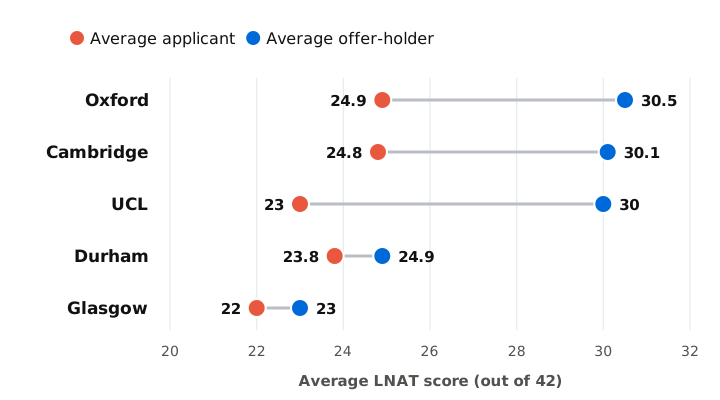
Here are the latest averages each university has published or released:
| University | Applicants | Offer-holders | Year |
|---|---|---|---|
| Oxford | 24.9 | 30.5 | 2026 entry |
| Cambridge | 24.8 | 30.1 | 2025 entry |
| UCL | 23 | 30 | 2025/26 cycle |
| KCL | 30.5 UK, 29.7 non-UK | 2023 entry | |
| LSE (UK applicants) | 28.3 standard offers, 25.3 contextual | 2024 entry | |
| Durham | 23.8 | 24.9 | 2025 entry |
| Bristol | 24.7 | 2022 entry | |
| Glasgow (approximate medians) | 22 | 23 | 2022-23 |
Sources: university admissions reports and Freedom of Information replies. Blank cells: not released.
The table splits into two groups. At Oxford, Cambridge, UCL and KCL, offer-holders average about 30.
At Durham, Bristol and Glasgow they average 23 to 25, much closer to the typical applicant.
That gap tells you how much each score is doing. Where offer-holders sit far above applicants, the LNAT is separating people.
Where they sit close, grades and the rest of the application decide more.
Your chance of an offer at each score
Averages hide the most useful question: if I score X, how often do people like me get an offer?
Oxford, UCL and LSE have released score-by-score lists of their applicants and offers under Freedom of Information.
We counted the offers in each score band:
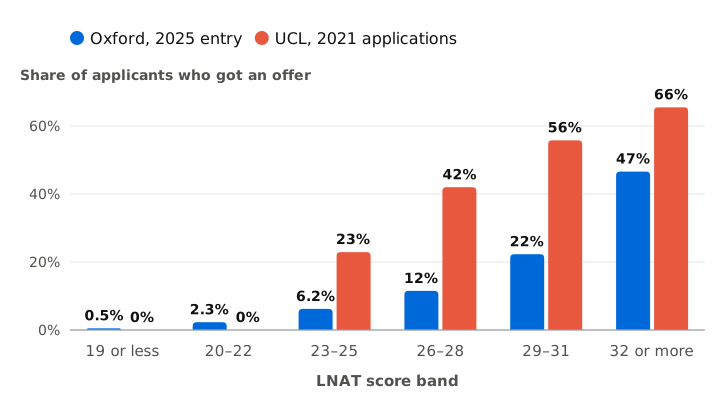
| LNAT score | Oxford, 2025 entry | UCL, 2021 | LSE, 2021 |
|---|---|---|---|
| 19 or below | 0.5% | 0% | 3.2% |
| 20 to 22 | 2.3% | 0% | 12.2% |
| 23 to 25 | 6.2% | 22.9% | 18.9% |
| 26 to 28 | 11.5% | 42.0% | 35.2% |
| 29 to 31 | 22.3% | 55.8% | 30.1% |
| 32 or more | 46.6% | 65.5% | 25.9% |
| All applicants | 13.3% | 15.1% | 16.7% |
GhostPrep's calculation from applicant score lists that Oxford, UCL and LSE released under Freedom of Information.
Each university's pattern is different, and each one is worth reading on its own:
Oxford roughly doubles your chances with every three marks. Below 26, fewer than 1 applicant in 16 got an offer. At 32 or more, almost half did. Our Oxford LNAT guide adds interview rates by score.
UCL made no offers below 23 in 2021. In a Freedom of Information reply in July 2021, it gave 23 as its cut-off for 2020-21 applicants. UCL resets this benchmark every year, so it can change.
LSE peaks at 26 to 28 and falls back above that. The highest scorers did not always get offers, which shows how much grades and the rest of the application count there.
KCL also released lists, for 2016 to 2020. They show offers going much further down the range, but KCL's overall offer rate fell from 46.7% in 2020 to 16.7% in 2023, so those older rates no longer describe it.
Where your score sits among applicants
LNAT does not tell you your percentile. The universities' score lists can, at least for their own applicants.
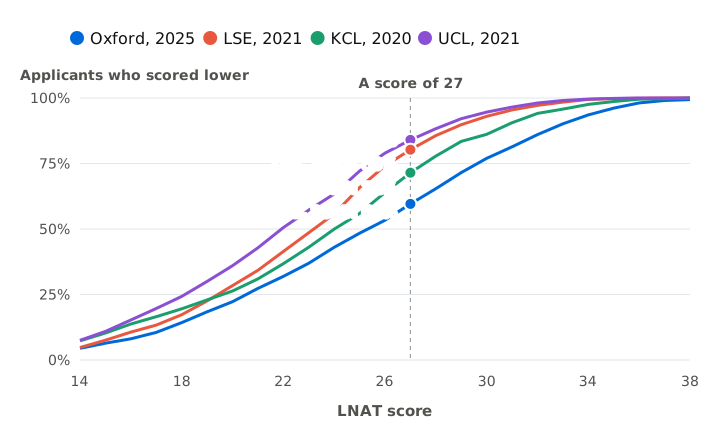
For exact figures, find your score on the left.
Each figure is the share of that university's applicants who scored lower than you:
| Your score | Oxford | LSE | KCL | UCL |
|---|---|---|---|---|
| 18 | 14% | 17% | 20% | 24% |
| 20 | 22% | 28% | 26% | 36% |
| 22 | 32% | 41% | 37% | 51% |
| 24 | 43% | 56% | 50% | 63% |
| 25 | 48% | 66% | 56% | 72% |
| 26 | 53% | 74% | 64% | 79% |
| 27 | 60% | 80% | 71% | 84% |
| 28 | 65% | 86% | 78% | 88% |
| 29 | 72% | 90% | 83% | 92% |
| 30 | 77% | 93% | 86% | 95% |
| 32 | 86% | 97% | 94% | 98% |
| 34 | 94% | over 99% | 98% | over 99% |
| 36 | 98% | over 99% | over 99% | over 99% |
GhostPrep's calculation from applicant score lists that Oxford, LSE, KCL and UCL released under Freedom of Information.
So a 27 beats 60% of Oxford's applicants and 84% of UCL's. The same score ranks very differently depending on who else applied.
Oxford's applicants are the strongest field in the table: its median applicant scored 25, against 21 at UCL in 2021.
Is 27 a good LNAT score? Answers by score
Putting the averages, offer rates and percentiles together, here is what each range of scores means in practice:
| Score | What it means |
|---|---|
| 33 or more | Excellent anywhere. Top 10% of Oxford's applicants, and above every university's offer-holder average |
| 30 to 32 | Very strong. Level with the average offer-holder at Oxford, Cambridge, UCL and KCL, and above 3 in 4 Oxford applicants |
| 27 to 29 | Good. Above the offer-holder average at Durham, Bristol and Glasgow, and competitive at LSE. Below the average offer-holder at the most selective four |
| 23 to 26 | Around the typical applicant. Offers at Oxford are possible but uncommon (6.2% at 23 to 25) |
| 20 to 22 | Below the typical applicant at most universities. Few offers at Oxford (2.3%), and none at UCL below 23 in 2021 |
| Under 20 | About the bottom 22% of Oxford's applicants. Offers from the most selective universities are rare |
Summarised from the tables above. Offer rates are Oxford 2025 entry unless stated.
So is 27 a good LNAT score? Yes.
It is above average at every university that publishes data, though at Oxford, Cambridge and UCL the rest of your application needs to be strong too.
A score of 23 is about average. It keeps most options open, but on its own it will not stand out at the most selective universities.
Good scores are rising
If you have seen an older guide say a 27 is enough for Oxford, it was describing a different field. Offer-holders' scores have climbed by two to three marks in five years.
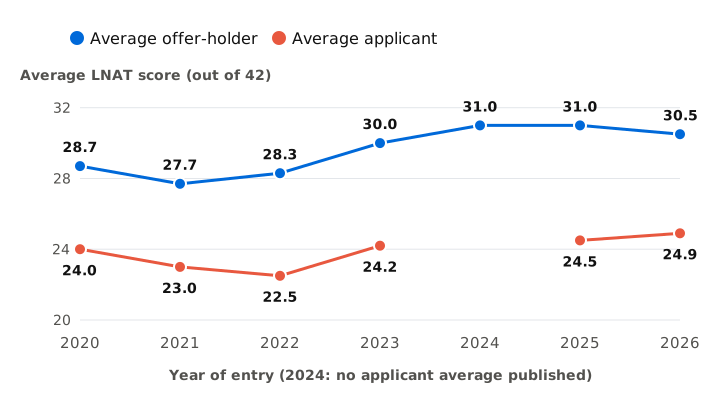
| Year of entry | All applicants | Offer-holders |
|---|---|---|
| 2020 | 24.0 | 28.7 |
| 2021 | 23.0 | 27.7 |
| 2022 | 22.5 | 28.3 |
| 2023 | 24.2 | 30.0 |
| 2024 | 31.0 | |
| 2025 | 24.5 | 31.0 |
| 2026 | 24.9 | 30.5 |
Source: Oxford Law Admissions Reports, 2019-20 to 2025-26. The 2024 report gave no applicant average.
UCL shows the same climb. Its offer-holders averaged 26 in 2018 and about 30 by 2025/26, according to its Freedom of Information replies and its own FAQ.
The practical lesson is to aim above the averages you read, not at them. A target set from 2021 figures is two or three marks too low.
Cut-offs, minimums and contextual offers
Several LNAT universities say they have no minimum score. Bristol and Durham say so on their own pages, and Oxford and LSE said the same in Freedom of Information replies in 2021.
A few do use a line, at least some years:
UCL sets a yearly benchmark from previous applicants' averages and does not publish it. Its Freedom of Information replies gave 23 for 2019 entry, or 20 for applicants eligible for its Access UCL scheme (November 2019), and 23 again for 2020-21 (July 2021).
IE University accepts the LNAT in place of its own test with a score of 22 or above.
Glasgow gave a cut-off of 18 for its 2020-21 applicants.
Contextual offers
Several universities take your background into account, and their offer-holders' scores show it:
UCL: contextual offer-holders averaged 27 in 2025/26, against 30 for all offer-holders.
LSE: UK applicants with contextual offers averaged 25.3 in 2024, against 28.3 for standard offers.
Durham: UK contextual offer-holders averaged 22.3 in 2021, against 26.7 for standard offers.
If you qualify for a contextual scheme, the averages above overstate the score you need. Check each university's eligibility rules.
The highest LNAT score ever
LNAT publishes no record of top scores, so nobody can say for certain. Claims of 42 out of 42 appear on forums but cannot be checked.
The highest scores in university data are:
41: the top score among Oxford's offer-holders for 2025 entry.
40: the top score among all Oxford applicants in its 2017 data.
39: the top score among Cambridge's offer-holders in 2025.
Scores that high are very rare. Only about 1% of Oxford's applicants for 2025 entry scored 37 or more.
Resits and problems on the day
You can sit the LNAT once per admissions cycle. A second sitting is automatically invalid, and results do not carry over to the next year.
The one exception is an authorised resit, which LNAT can offer if something affects you during the test, such as disruption at the centre or sudden illness. Report it to the staff before you leave, get an incident number, then contact LNAT.
If you take an authorised resit, UCL uses the resit score even if it is lower. Other universities may do the same, so only resit if the first sitting was genuinely affected.
Your result itself is never adjusted, and KCL says it cannot consider mitigating circumstances for the LNAT. If you feel unwell before the test, reschedule before the cut-off rather than sit.
For everything else about the test, from format to fees, see our complete guide to the LNAT.
LNAT results and scores FAQ
When do LNAT results come out?
Universities get your score within 24 hours of your test, or from 21 October for tests taken earlier. You get it by email in mid-February if you sat on or before 26 January, or in mid-August if you sat later.
What is a good LNAT score?
It depends on the university. 27 or more is above average everywhere that publishes data, and about 30 matches the average offer-holder at Oxford, Cambridge and UCL.
What is the average LNAT score?
Applicants to the universities that publish data average about 22 to 25. Oxford's applicants averaged 24.9 in 2025-26, Cambridge's 24.8 and UCL's 23. LNAT's last national figures, from 2015-16, put the average candidate at about 23.
Is 27 a good LNAT score?
Yes. It beat 60% of Oxford's 2025 applicants and 84% of UCL's 2021 applicants, and it is above the average offer-holder at Durham, Bristol and Glasgow.
Is 23 a bad LNAT score?
No. It is close to the typical applicant's score. It will not stand out at Oxford, Cambridge or UCL, where offer-holders average about 30, but it is near the offer-holder average at Glasgow and within reach of Durham and Bristol's.
Is 17 a bad LNAT score?
It is low. Only about 11% of Oxford's 2025 applicants scored below 17. Offers from the most selective universities are rare at that level, though not unknown elsewhere.
What LNAT score does Oxford want?
Oxford publishes no minimum. Its offer-holders averaged 30.5 in 2025-26, and in 2025 almost half of applicants scoring 32 or more got an offer.
Is the LNAT essay scored?
Not by LNAT. It goes to your universities unmarked, and each one decides how to assess it. Oxford and Cambridge mark it themselves; LSE does not consider it for most applicants.
Can you fail the LNAT?
No. There is no pass mark. Bristol puts it simply: you have done well if you get more than half of the questions right.
Do I need to send my LNAT result to universities?
No. Universities download your score and essay themselves, matched to your UCAS application.
Raise your LNAT score with GhostPrep
Every three marks roughly doubled an applicant's chance of an Oxford offer in 2025. Those marks come from timed practice on the real format.
Free to start · 2 passage sets a day · no card required
Sources
The figures on this page come from these official reports, pages and Freedom of Information replies:
| What | Source |
|---|---|
| When results come out | LNAT's results page; Oxford Law Admissions Report 2025-26 |
| How universities use the essay | Oxford Law Admissions Report 2025-26; Cambridge application statistics; UCL applying and entry requirements; Durham Law course page; Bristol 2027 Law admissions statement and a Bristol Freedom of Information reply (December 2022) |
| Average scores by university | Oxford Law Admissions Report 2025-26; Cambridge application statistics; UCL applying and entry requirements; Freedom of Information replies from KCL, LSE, Durham, Bristol and Glasgow. KCL's figure is GhostPrep's average of its UK and non-UK figures |
| Offer chances by score | GhostPrep's calculation from applicant score lists released under Freedom of Information by Oxford (Law, 2025 entry, 1,767 applicants), UCL (2021, 4,359) and LSE (2021, 2,067; first-decision offers). Small numbers a university hid are counted as zero |
| Where your score sits | GhostPrep's calculation from the same lists for Oxford, LSE and UCL, plus KCL (2020, 1,719). UCL does not list scores held by fewer than five applicants |
| Oxford scores over time | Oxford Law Admissions Reports, 2019-20 to 2025-26 |
| UCL's cut-off | UCL Freedom of Information replies of November 2019 and July 2021 |