

Oxford LNAT: scores, shortlisting and your chance of an offer
What LNAT score Oxford Law offer-holders actually get, how Oxford uses the test to choose who to interview, how it marks the essay, and your chance of an offer at every score.
Written by the specialists behind our practice bank — over a decade writing, teaching and tracking the UK admissions tests.
What LNAT score does Oxford want?
Oxford sets no LNAT cut-off. It said so in a Freedom of Information reply in 2021, and it has published none since.
In practice, Oxford's offer-holders averaged 30.5 out of 42 for 2026 entry, against 24.9 for all applicants. Offers went to applicants scoring anywhere from 16 to 41 for 2025 entry (Law, M100).
Your chance of an offer rises steeply with the score. For 2025 entry, 46.6% of applicants scoring 32 or more got one, against 6.2% at 23 to 25.
From Oxford's Law Admissions Report 2025-26, covering Law and Law with Law Studies in Europe.
That is about 1 offer for every 8 applicants. The rest of this page shows where the LNAT helps you through that funnel, and where other things take over.
Oxford's LNAT requirements for 2027 entry
Oxford says "All applicants must take" the LNAT for its Law course.
That covers every course in the Law family:
| Course | UCAS code | Length |
|---|---|---|
| Law (Jurisprudence) | M100 | 3 years |
| Law with European Law (The Netherlands), taught at Leiden | M190 | 4 years |
| Law with French Law | M191 | 4 years |
| Law with German Law | M192 | 4 years |
| Law with Italian Law | M193 | 4 years |
| Law with Spanish Law | M194 | 4 years |
| Foundation Year in Law | Separate scheme | 1 year, then the degree |
From Oxford's Law course page, checked 15 October 2026.
Oxford's process for 2027 entry runs to these dates:
- 15 September 2026 — Last day to register and book the LNAT (closed)
- 15 October 2026 — Last day to sit the LNAT. UCAS deadline, 6pm
- Late October 2026 — Tutors can see your score and essay (24 October last year)
- Mid-November to early December — Shortlisting: you hear whether you are invited to interview
- 7 to 9 December 2026 — First-college interviews, online
- 11 December 2026 — Second-college interviews, for those invited
- 12 January 2027 — Decisions, through UCAS
- 15 February 2027 — Last day to request feedback from your college
From Oxford's admissions timeline, interview timetable and decisions pages, and its 2025-26 Law report, checked 15 October 2026.
Two practical rules matter for your score to arrive. You must select Oxford in your LNAT account, because Oxford can only see the results of candidates who do, and your UCAS ID must be correct.
The Foundation Year in Law, open to eligible UK state-school students, also requires the LNAT. Its UCAS deadline is 13 January 2027, and Oxford says to take the test before that date.
Oxford asks for no written work for Law. As its Law Faculty puts it, it uses the LNAT in its assessments instead.
Oxford LNAT averages, year by year
Oxford's Law Faculty publishes an admissions report each year.
Together they show a clear climb in the scores of the people it interviews and makes offers to:
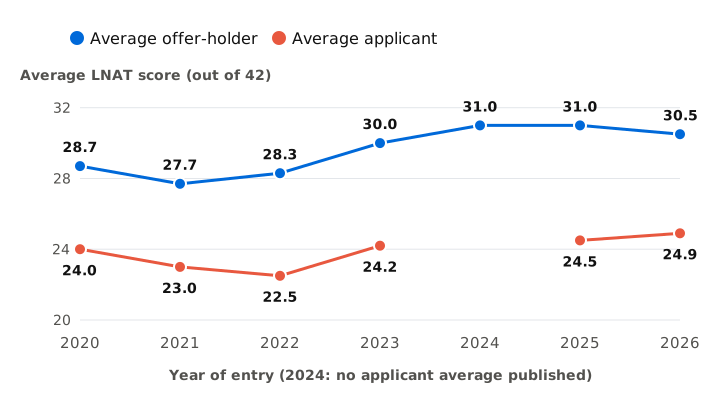
| Entry | Applicants | Offers | Average applicant | Average interviewee | Average offer-holder |
|---|---|---|---|---|---|
| 2020 | 1,820 | 266 | 24.0 | 27.7 | 28.7 |
| 2021 | 1,899 | 238 | 23.0 | 26.5 | 27.7 |
| 2022 | 2,046 | 228 | 22.5 | 27.0 | 28.3 |
| 2023 | 2,141 | 240 | 24.2 | 28.3 | 30.0 |
| 2024 | 2,125 | 241 | 29.5 | 31.0 | |
| 2025 | 2,061 | 247 | 24.5 | 29.2 | 31.0 |
| 2026 | 2,115 | 252 | 24.9 | 29.4 | 30.5 |
From Oxford's Law Admissions Reports, 2019-20 to 2025-26, covering Law and Law with Law Studies in Europe. The 2024 report gave no all-applicant average, and one copy of the 2023 report gives 28.8 for interviewees.
Three things stand out:
Offer-holders have climbed about three marks. From 27.7 for 2021 entry to 30 or more in every year since 2023.
The typical applicant has moved much less. All applicants averaged between 22.5 and 24.9 throughout, so the gap between applicant and offer-holder has widened.
Places have stayed flat. Applications rose from about 1,800 to over 2,100, while offers stayed at roughly 230 to 270.
So an older guide that calls 27 "enough for Oxford" describes a different field. For recent cycles, 30 sits in the middle of the offer-holder range.
Your chance of an interview and an offer at each score
Oxford has released score-by-score lists of its Law applicants under Freedom of Information.
We counted how many in each score band were invited to interview and how many got an offer:
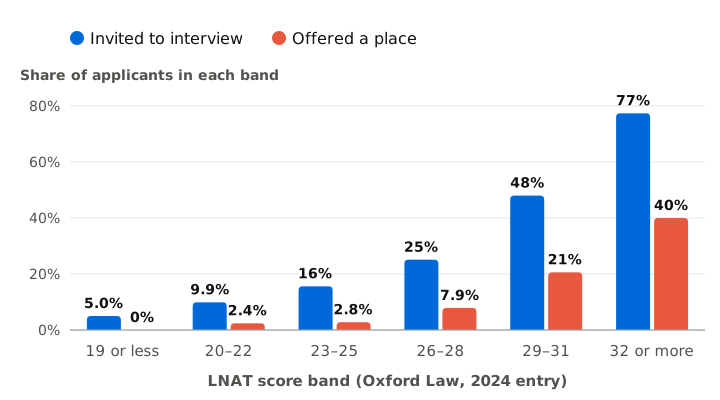
| LNAT score | Interviewed, 2023 | Interviewed, 2024 | Offer, 2023 | Offer, 2024 | Offer, 2025 |
|---|---|---|---|---|---|
| 19 or below | 4.2% | 5.0% | 0.6% | 0.0% | 0.5% |
| 20 to 22 | 15.7% | 9.9% | 2.4% | 2.4% | 2.3% |
| 23 to 25 | 19.7% | 15.6% | 3.9% | 2.8% | 6.2% |
| 26 to 28 | 42.6% | 25.1% | 11.3% | 7.9% | 11.5% |
| 29 to 31 | 65.5% | 48.0% | 28.7% | 20.6% | 22.3% |
| 32 or more | 82.1% | 77.4% | 44.7% | 40.0% | 46.6% |
| All applicants | 33.4% | 29.8% | 12.1% | 11.7% | 13.3% |
GhostPrep's calculation from applicant lists Oxford released under Freedom of Information (Law, M100). Oxford's 2025 data does not show which applicants were interviewed at each score, so 2025 has offer rates only.
Read down the offer columns and the pattern is consistent. Each step of three marks roughly doubles your chance of an offer, from about 1 in 40 at 20 to 22 to nearly 1 in 2 at 32 or more.
The interview column matters just as much. In 2024, three in four applicants scoring 32 or more were interviewed, but only one in four scoring 26 to 28.
The same score buys less than it used to
Oxford's older lists go back to 2012 entry, and they show how much tougher the middle of the range has become:
| Year of entry | Applicants | Offer at 26 to 28 | Offer at 29 to 31 | Offer at 32 or more |
|---|---|---|---|---|
| 2012 | 1,149 | 43.7% | 53.3% | 60.0% |
| 2015 | 1,232 | 16.7% | 37.1% | 53.8% |
| 2018 | 1,492 | 31.3% | 48.7% | 87.5% |
| 2021 | 1,607 | 19.7% | 38.9% | at least 50.9% |
| 2023 | 1,814 | 11.3% | 28.7% | 44.7% |
| 2024 | 1,825 | 7.9% | 20.6% | 40.0% |
| 2025 | 1,767 | 11.5% | 22.3% | 46.6% |
GhostPrep's calculation from Oxford Freedom of Information replies (Law, M100, applicants with a score). Oxford hid small 2021 counts, so that year's top figure is a minimum. The 2012 and 2018 figures for 32 or more rest on 10 and 32 applicants.
A score of 26 to 28 got an offer more than 4 times in 10 for 2012 entry, and closer to 1 in 9 for 2025 entry.
More applicants are now competing for the same number of places, and more of them score highly.
How Oxford uses the LNAT to shortlist
Oxford says the LNAT is used "both when shortlisting and when making the final admissions decisions". Shortlisting is where it does most of its work.
Before interviews, the Law Faculty ranks every applicant.
For the 2025-26 round (2026 entry), its report describes two ranks:
Candidates with a contextualised GCSE score were ranked 10% on the LNAT multiple-choice score, 10% on the LNAT essay and 80% on contextualised GCSEs. Contextualised means your GCSEs are compared with the results of students at similarly performing schools.
Candidates without one, which in practice includes most applicants educated outside the UK, were ranked on the two LNAT scores equally. Oxford then adjusts those decisions in the light of their school qualifications.
That 80% weighting is new. The reports for 2022 and 2025 entry described the same three factors as equally weighted.
Oxford has not said why it changed, or what weights it will use for 2027 entry.
Oxford's internal admissions manuals, released under Freedom of Information, add three rules that shape how the rank is used:
The top of the rank is shortlisted automatically. Candidates in the first category, one for each place, go straight through.
The rank should "guide but not bind". In the 2021 and 2023-entry manuals, tutors read applications, and outstanding strength in one area can make up for weakness in another.
A weak LNAT can count against you. The 2023-entry manual listed a poor multiple-choice score, or a poor essay, "not compensated by strength elsewhere" as reasons not to shortlist. The 2025 version cites GCSEs and LNAT scores "in combination not sufficient".
Contextual information can also help. Oxford says applicants from the most disadvantaged backgrounds are strongly recommended for interview.
Its 2025-26 report also describes extra consideration for candidates from the most deprived backgrounds who did well compared with others at their school.
How Oxford marks the LNAT essay
LNAT does not mark the essay. Oxford marks it itself, and it is one of the few universities that turns it into a number used in the rank.
Since the 2020-21 admissions round, Oxford has used comparative judgement, through software called No More Marking.
Trained markers see two anonymised essays at a time and choose the better one, each essay is judged several times, and the software turns those choices into a mark.
The marks sit on Oxford's own scale. In practice nearly every essay scores between 50 and 75, and offer-holders averaged 65.2 for 2026 entry against 62.4 for all applicants.
Oxford released its essay criteria under Freedom of Information in 2021.
Markers compare essays on all three:
| Criterion | What a strong essay shows | What a weak essay shows |
|---|---|---|
| 1. Application | Close attention to the question, and focused treatment of the issues all the way through | Drifts from the question |
| 2. Reasoning ability | Well-drawn distinctions, a keen eye for relevance, awareness of more than one possible line of argument, independent judgement | Underdeveloped arguments and irrelevant points |
| 3. Communication | Clear, fluent writing with a structure that fits the argument | Unclear writing with no clear structure |
Summarised from Oxford's reply to a Freedom of Information request on LNAT essay marking criteria, September 2021.
Offer rates rise sharply with the essay mark, even among high scorers.
Here is the offer rate within each score band, split by essay mark, for 2025 entry:
| LNAT score | Essay 62 or below | Essay 63 to 65 | Essay 66 or above |
|---|---|---|---|
| 26 to 28 | 7% | 12% | 19% |
| 29 to 31 | 10% | 24% | 35% |
| 32 or more | 16% | 47% | 64% |
GhostPrep's calculation from Oxford's Freedom of Information data for 2025 entry (Law, M100).
At 32 or more, applicants with an essay mark of 66 or above got an offer 64% of the time, against 16% for those at 62 or below. The 2023 and 2024 data show the same pattern.
For how other universities treat the essay, and how to write one that meets these criteria, see our guide to how universities mark the LNAT essay.
After the shortlist: the interview decides
Shortlisted candidates usually get two interviews of about 25 minutes at their first college, online. Some are then invited to a second college for one more.
Oxford's 2025-26 report says candidates were asked about their schoolwork and given scenarios to test their logical reasoning. Some colleges send a short reading in advance.
Once you are interviewed, the interview score does most of the work.
Here is how often interviewees got an offer, by the score their first college gave them, for 2025 entry:
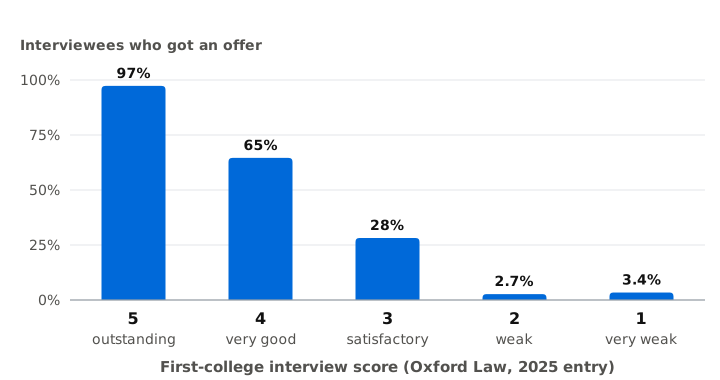
A first-college interview score of 5 led to an offer 97% of the time, and a 2 or a 1 almost never did. Oxford's post-interview rank adds "a small addition of first interview scores" to the shortlisting rank, and colleges then make their own decisions.
So the LNAT's main job at Oxford is getting you into the room. After that it still counts, but the interview carries the decision.
Why a high score is no guarantee
A top LNAT score makes an offer far more likely, but Oxford's data shows it does not secure one:
2025 entry: 68 applicants scored 35 or more, and 23 of them got no offer. One scored 40. Oxford's data does not give reasons.
2024 entry: an applicant who scored 39 was not invited to interview.
2025 entry: the lowest-scoring offer-holder had 16, and the highest had 41, the highest score in any Oxford data we have found.
GhostPrep's calculation from Oxford's Freedom of Information data (Law, M100).
Oxford's data does not give reasons, but the process above suggests some:
GCSEs and school results feed the shortlisting rank alongside the LNAT.
The essay shifts the odds within a score band.
The interview carries most of the final decision.
Does your college choice change your chances?
Less than the raw numbers suggest. In 2025, Law applications per college ranged from 20 to 186, but each college made only 4 to 12 offers.
That looks like a huge gap in odds, but Oxford moves strong candidates between colleges.
Its first shortlist is drawn up without regard to college, and unreserved candidates are spread across the Faculty "to maximise each candidate's chance of receiving an offer".
The result: for 2025 entry, 106 of 235 Law offers (45%) came from a college other than the one the applicant chose or was allocated to.
GhostPrep's calculation from Oxford's Freedom of Information data for 2025 entry (Law, M100).
So choose a college for reasons that matter to you. A "less popular" college is a weak strategy, and Oxford's Law Faculty says each college applies exactly the same criteria.
UK and international applicants
Over a third of Oxford's Law applicants come from outside the UK.
In recent years they have been less likely to get an offer:
| Year of entry | UK: interviewed | UK: offer | International: interviewed | International: offer |
|---|---|---|---|---|
| 2023 | 34.1% | 12.7% | 29.9% | 10.2% |
| 2024 | 32.4% | 13.7% | 23.1% | 7.3% |
| 2025 | 35.0% | 14.1% | 25.5% | 10.9% |
GhostPrep's calculation from Oxford's Freedom of Information data by UK and international domicile (Law, M100).
Most international applicants have no contextualised GCSE score, so their shortlisting rank rests on the two LNAT scores and a review of their school results. For them, the LNAT carries far more weight than it does for UK applicants.
Oxford's internal guidance aims for a shortlist of roughly two-thirds home and one-third overseas candidates. Oxford says this is a general guide, not a quota.
What to aim for
This section is our advice. Oxford publishes no target score; these goals come from the data above.
Aim for 30 or more on Section A. It puts you level with the average offer-holder, and between half (2024 entry) and two-thirds (2023 entry) of applicants at 29 to 31 were interviewed.
Treat the essay as part of your score. At Oxford it is marked and ranked, and within a score band, applicants with the strongest essays had two to four times the offer rate of those with the weakest.
If you have no GCSEs, the LNAT matters even more. Your shortlisting rank leans on it, so give Section A and the essay the most preparation time you can.
Prepare for the interview as well. Once you are shortlisted, it carries most of the decision.
For Oxford applicants this cycle, the LNAT closes on 15 October. If you are reading this ahead of a future application, our complete guide to the LNAT sets out a preparation plan, and our free LNAT practice test shows the real four-option format.
To compare Oxford with the other LNAT universities, see what is a good LNAT score.
Oxford LNAT FAQ
What LNAT score do you need for Oxford?
There is no minimum. Offer-holders averaged 30.5 for 2026 entry, and offers went to applicants scoring from 16 to 41 for 2025 entry.
What is the average LNAT score for Oxford?
For 2026 entry, Oxford's Law applicants averaged 24.9, interviewed candidates 29.4 and offer-holders 30.5, according to its 2025-26 admissions report.
Does Oxford have an LNAT cut-off?
No. Oxford told a Freedom of Information requester in 2021 that "there is no cut-off score", and it publishes none.
How much does the LNAT count at Oxford?
For 2026 entry, the LNAT made up 20% of the shortlisting rank for candidates with contextualised GCSEs, 10% for each section. For candidates without one, the rank rested on the two LNAT scores, then was adjusted for school qualifications.
Does Oxford mark the LNAT essay?
Yes. Oxford marks it by comparative judgement on its own scale, where most essays score 50 to 75, and uses the mark in its shortlisting rank.
Can I get into Oxford with an LNAT score of 25?
It is possible but uncommon. For 2025 entry, 6.2% of applicants scoring 23 to 25 got an offer, against 46.6% at 32 or more.
Is 34 a good LNAT score for Oxford?
Yes. It beat about 94% of Oxford's applicants for 2025 entry, and nearly half of applicants scoring 32 or more got offers.
When does Oxford see my LNAT score?
Universities receive scores for tests taken by 20 October in a first batch on 21 October. Oxford's tutors had them on 24 October last year, well before you get your own result in February.
Do I need the LNAT for Law with Law Studies in Europe?
Yes. Every course in Oxford's Law family needs the LNAT, and the French, German, Italian and Spanish options also have a language test at interview.
Prepare for the LNAT with GhostPrep
Oxford rewards a high Section A score and a sharp essay, and both improve with timed practice.
Free to start · 2 passage sets a day · no card required
Sources
Every fact on this page comes from these sources, checked on 15 October 2026. Freedom of Information figures are GhostPrep's own counts from the data Oxford released.
Here's how that breaks down:
| What | Source |
|---|---|
| Courses, requirements and dates | Oxford's Law course page, interview timetables and the Law Faculty's BA Jurisprudence page |
| Averages, applicants, interviews and offers | Oxford Law Admissions Reports, including the 2025-26 report, the 2024-25 report and the 2023-24 report |
| Interview and offer rates by score, 2023 and 2024 | Oxford's Freedom of Information reply of 2 September 2025, LNAT distribution graphs for applicants and offer holders |
| Offer rates by score, essay and interview score, 2025 | Oxford's Freedom of Information reply of 22 July 2025, Oxford Law admissions data 2025 |
| Offer rates by score, 2012 to 2021 | Oxford's Freedom of Information replies on admission statistics for BA Jurisprudence (April 2017), Law applicant statistics (September 2017), the 2018 admissions cycle (January 2019) and LNAT multiple choice score distribution (August 2021) |
| College and domicile figures, top and bottom scores | The reallocation figure and the 2025 high scorers come from the July 2025 reply above. Oxford's Freedom of Information reply of 23 December 2025, Law admissions information from 2022-25 |
| No cut-off | Oxford's Freedom of Information reply of 20 July 2021, LNAT statistics |
| Essay marking method and criteria | Oxford's Freedom of Information replies on internal guidelines and admissions criteria (July 2021) and LNAT essay marking criteria (September 2021) |
| Shortlisting rules | Oxford's Freedom of Information replies on internal guidelines and admissions criteria (July 2021), the shortlisting process for Law (August 2023) and the admissions procedures document, 2025 cycle (March 2025) |