1
Learn the method
Nineteen teaching chapters. Every Paper 1 question family and every Paper 2 reasoning type gets its own chapter, its own technique and its own set of traps, with the method the official solutions themselves use.


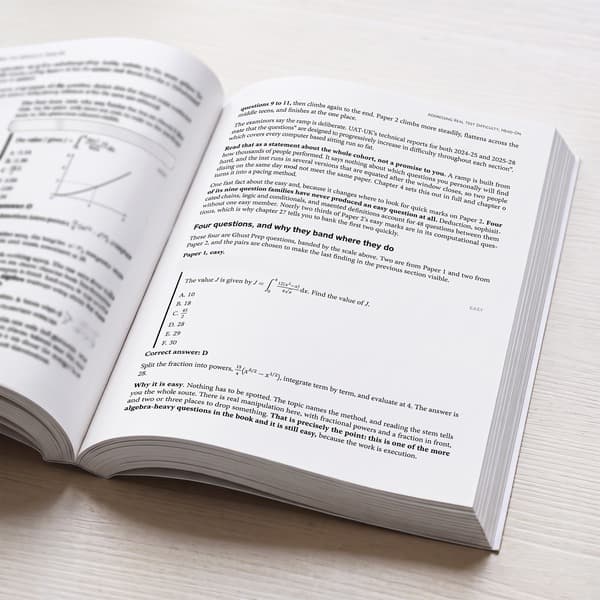
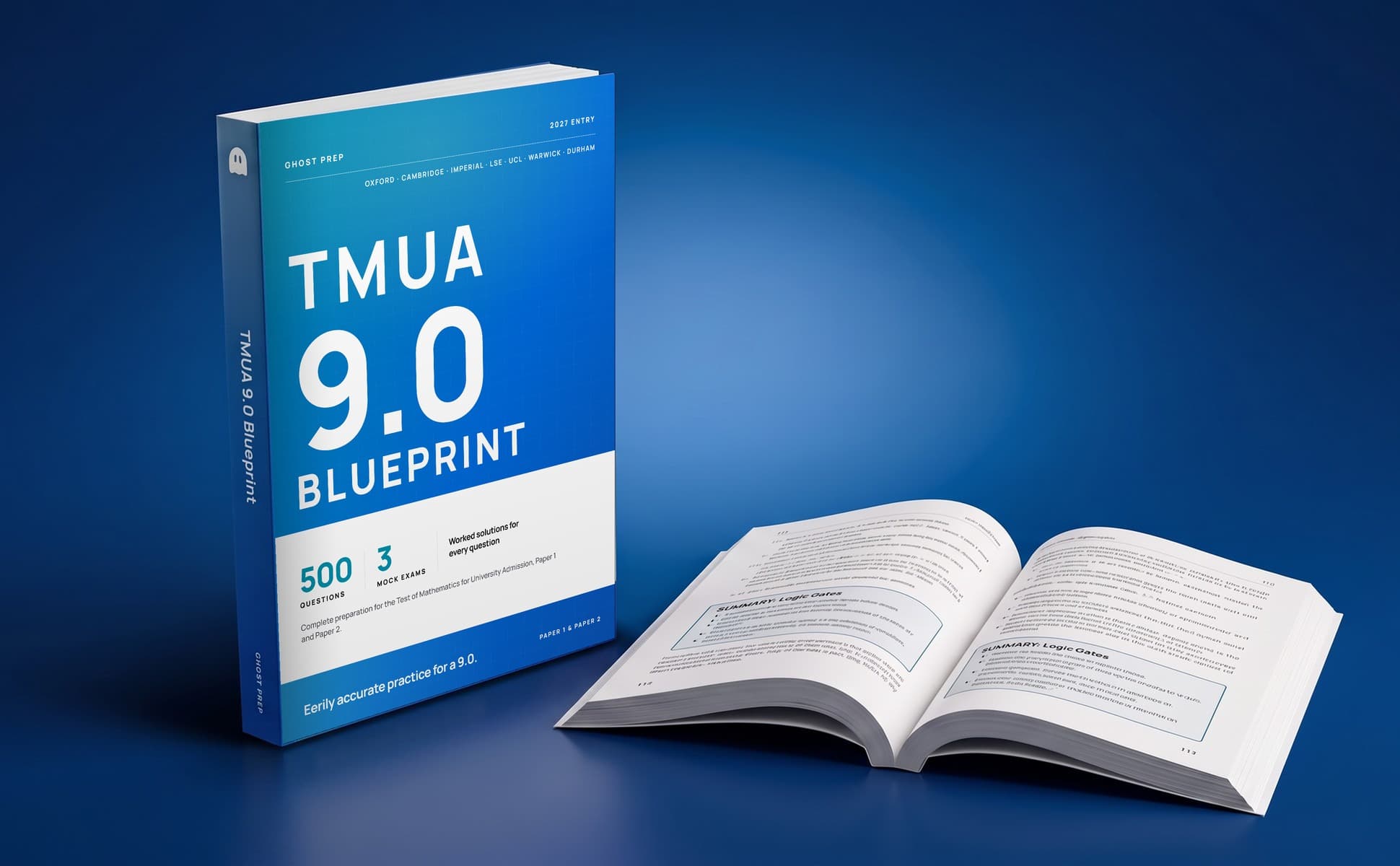
TMUA 9.0 Blueprint is 510 pages of teaching, practice and worked solutions: 39 chapters, 500 original questions with the difficulty band printed beside each one, a full course in Paper 2's logic and proof, three full mock exams, and a worked solution for every single question in the book.
Paperback. Price, delivery and returns are set by Amazon.
UAT-UK has published eight sittings of past papers and a specimen — 360 questions, every one written for the paper exam that ended in 2024. Use all of them. Then notice that they come with worked answers rather than teaching, that no paper from the on-screen era has been released, and that you only get to sit each one cold once.
Learn the test on the past papers and you have nothing left to check yourself against when it would count. This book is the practice you do first, so the official papers can be what they are best at: a readiness check under real conditions.
Paper 2 is logic and proof — necessary and sufficient, quantifiers and negation, counterexample, error-spotting — and almost nobody meets it at school. Part 2 of the book is a course in it, from nothing.
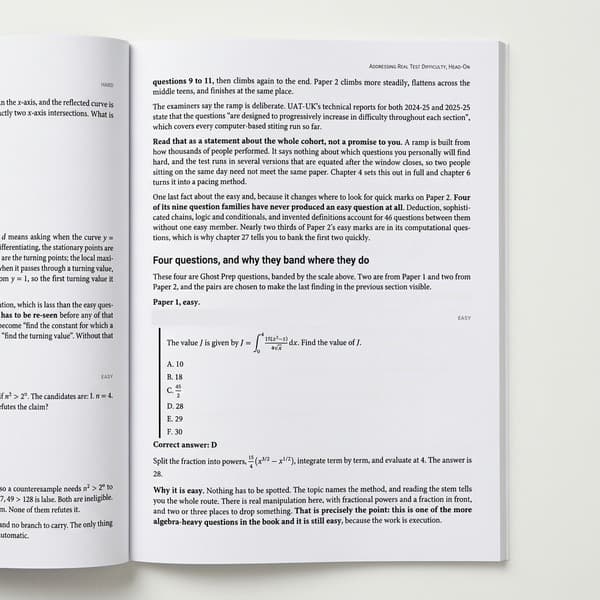
There are no difficulty labels on the day. Every practice question in this book prints its band beside it, on a scale fitted to all 360 official questions, so a question that fights you tells you where to practice rather than just costing you time.
Two papers, three stages, in the order you would actually work through them. Start at chapter one if you are new to the test, or sit the diagnostic in chapter 7 and let it set your order.
Nineteen teaching chapters. Every Paper 1 question family and every Paper 2 reasoning type gets its own chapter, its own technique and its own set of traps, with the method the official solutions themselves use.
140 Paper 1 and 140 Paper 2 questions, graded against the measured difficulty of the real papers and banded on the page, plus a 20-question diagnostic and 120 more across the three mocks.
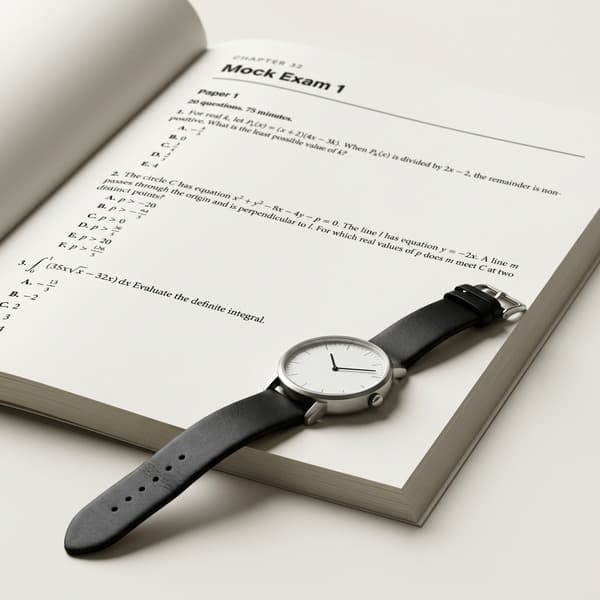
Three full mock exams, six papers, each built question by question to the family mix and difficulty ramp of a real sitting. 75 minutes a paper, back to back, no calculator, working on a whiteboard.
An answer key tells you that you were wrong. A worked solution tells you where the working went wrong, which is the only part that changes what you do next time.
All 500 questions are worked in full, in the shape the official solutions use: the answer, the method that actually runs, then a line on each wrong option that was built to catch a particular slip, saying which one. Most wrong options on the TMUA are reachable by one predictable mistake, and knowing which one you made is worth more than knowing you made it.
The real exam never labels a question, but it does get harder as it goes, and the mix is measured: about a quarter easy, half medium and a quarter hard on Paper 1, with Paper 2 heavier at the top. Every practice question in the book prints its band beside it, on a scale fitted to all 360 official past-paper questions. Three from the book, worked at their bands.
Nothing to spot. The topic names the method, and the working is two lines.
Paper 1 practice set · Question 8
The equation x2 + px + q = 0 has roots 22 and 32. What is p + q?
Worked solution
The correct answer is C.
One non-obvious move, then a routine method. Half of each paper.
The diagnostic · Question 4
For real values of x, 25x−1 − 630 · 5x−1 + 3125 = 0. What is the positive difference between the two values of x?
Worked solution
The correct answer is B.
The whole problem has to be re-seen before any algebra helps.
Chapter 5 · Paper 1, hard
The curve C has equation y = x5 − 5x3 + 1. It is reflected in the x-axis, and the reflected curve is then translated vertically downwards until it first has exactly two x-axis intersections. What is the equation of the image curve?
Worked solution
The correct answer is B.
Measured across all 360 official questions: Paper 1 is 23% easy, 53% medium and 24% hard; Paper 2 is 19%, 51% and 31%. Chapter 5 sets out what the scale measures — how much you have to reformulate before you can start, how many cases you carry, how much manipulation is involved, how precise you have to be, and how many layers deep the argument runs. The bands are applied by the same measurement to every question we write.
Paper 2 asks you to decide whether an argument holds, whether one claim follows from another, and where a proof goes wrong. That is a real branch of mathematics with its own rules, and almost nobody meets it at school.
So Part 2 is a course in the ordinary sense, taught from nothing: an introduction to the paper, seven chapters on the kinds of reasoning it tests, one on its computational questions, a field guide to the answer formats Paper 2 uses and Paper 1 never does, and its own 140-question graded practice set. It closes with eight named shortcuts taken from UAT-UK's own worked answers.
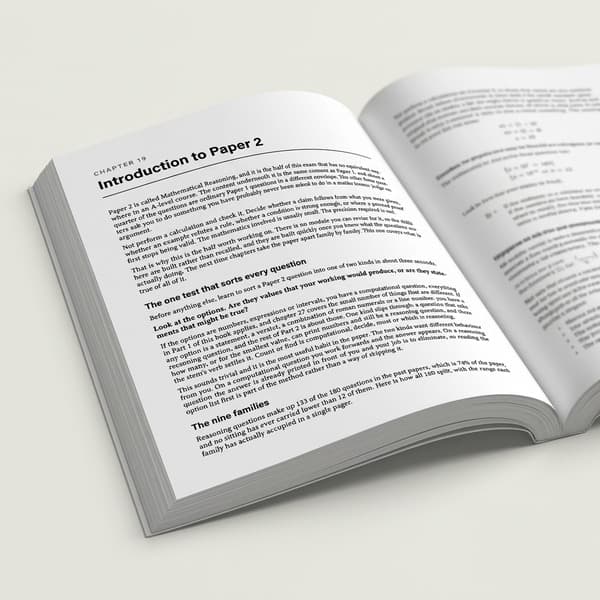
Written to be worked through from the first page to the last, and indexed well enough to dip into if you would rather not.
What the TMUA is and who requires it, what your score means in percentile terms, what the real exam screen looks like, how hard the real papers are, and how to pace 75 minutes with no calculator and a whiteboard. Then a 20-question diagnostic that shows you where you are weak before you spend a month practicing the wrong thing.
One chapter for each of the nine question families, in specification order: algebra and functions, sequences and series, coordinate geometry, trigonometry, exponentials and logarithms, differentiation, integration, graphs and transformations, and the GCSE tail. Each shows the shapes the questions come in, the traps built into the options, and the shortcuts that cut them down. Closes with a 140-question graded practice set.
A full course in logic and proof, taught from nothing: the language of logic, necessary and sufficient conditions, quantifiers and negation, proof and counterexample, what follows from what, sophisticated chains and invented definitions, error-spotting in purported proofs, and a field guide to the answer formats Paper 2 uses and Paper 1 never does. Closes with a 140-question graded practice set and a chapter of eight named shortcuts taken from UAT-UK's own worked answers.
Six papers, each built question by question to the structure of a real sitting: family mix, difficulty ramp, option counts and answer formats. Sit them timed and back to back, so a mock costs you the same two and a half hours the real thing will.
Answer keys, full worked solutions for all 500 questions, a coverage table showing which question family each question tests, and the formulae you must memorise because there is no formulae booklet, with a methods sheet for each paper alongside them.
Some people think better with a book open and a pen in their hand. Some need the clock running and the real interface in front of them. Most end up wanting a bit of each, which is why these are built to sit alongside one another rather than compete.
Better when you are learning the method and want to work at your own pace.
Better when you know the method and need volume, timing and the real conditions.
There is a code inside the book that brings the price of a paid plan down for readers. You do not need it to start: the free account is free either way.
Marked as you go, with a line on why. A free account adds the full worked solution on each; the book gives you 500 more in print, in the order they are best learned.
5 original TMUA questions, written to the current spec. See how you do before you commit to anything.
Evaluate
The TMUA is sat by applicants for mathematics, computer science, economics and related courses at Cambridge, Oxford, Imperial, LSE, Warwick, Durham and UCL. The book covers both papers in full: Paper 1's applications of mathematical knowledge and Paper 2's mathematical reasoning, including the logic and proof that school does not teach.
If you are starting from scratch, start at chapter one. If you already know the test and want volume, sit the diagnostic and go where it sends you. Parents and teachers get the same thing the candidate does — the worked solutions are written to be read by someone who has never sat the test.
No. GhostPrep is independent and is not affiliated with, endorsed by or connected to UAT-UK, Pearson VUE or any of the universities that use the TMUA. Every question in the book was written for the book — none is copied from the official papers. The teaching is grounded in the nine published past papers and their official worked answers, and where the public evidence runs out, the book says so rather than guessing.
No. The book is complete on its own — teaching, practice and worked solutions for both papers. The platform adds the things paper cannot do: the clock, a test player built to match the Pearson VUE one, a far larger bank of banded questions, peer statistics on every question, and instant marking. The three mocks in the book are on there too, so you can sit them on screen once you have sat them on paper. Which suits you is a question about how you learn, not about which is better.
Easy, medium or hard, on a scale we built by scoring all 360 official past-paper questions against the examiners' own worked answers. It measures what the working demands — how much reformulation, how many cases, how much manipulation, how much precision, how many layers — rather than how familiar the topic is. The real paper never labels a question, but it does get harder as it goes, and the bands tell you where a practice question would sit on that ramp.
A large-format A4 paperback, 510 pages, with a greyscale interior. It is a big book — the format is deliberate, because a practice set laid out at exam width and a worked solution you can annotate both need the room.
Working both courses and both practice sets properly is a term's work at a sensible pace, and each mock is two and a half hours on top. It is built to be started months out, not the week before, though the diagnostic in chapter 7 means a late start can go straight to the chapters it needs and the mocks.
It is sold on Amazon, which handles payment, delivery and returns under its own policy. The price, the delivery estimate and the returns window are all set by Amazon rather than by us. If there is a problem with the content of the book itself, contact us directly and we will sort it.
The test as UAT-UK sets it now: on screen at a Pearson VUE centre, two 75-minute papers of 20 questions each, no calculator, one score on the 1.0 to 9.0 scale. The mocks follow the family mix, difficulty ramp, option counts and answer formats of a real sitting, and the chapter on the exam screen shows what you will actually see on the day.
Buy the book, start free on the platform, or do both. They were built to go together.