1
Learn the method
Seventeen teaching chapters. Every Critical Thinking question type and every Problem Solving skill gets its own chapter, its own technique and its own set of traps.


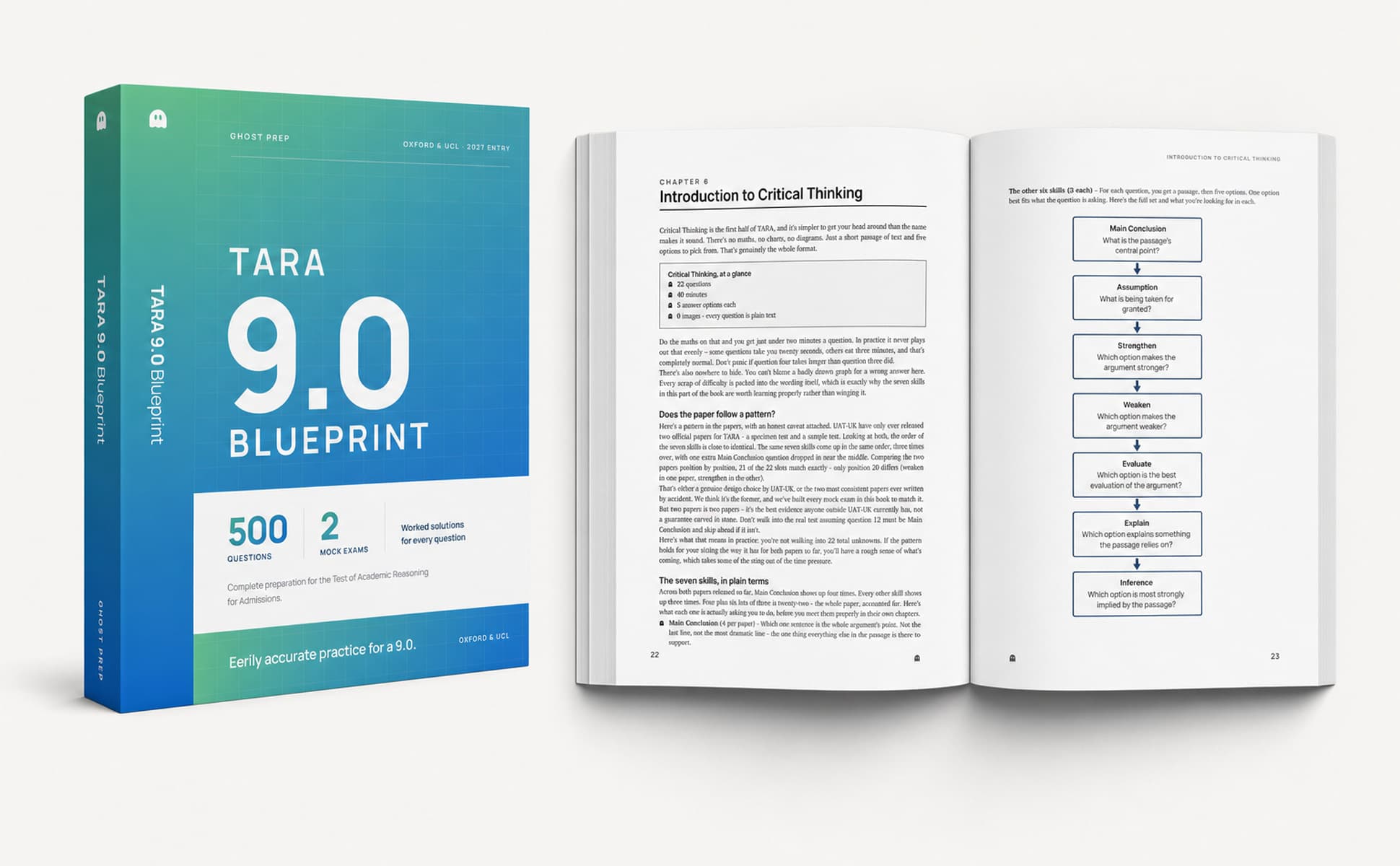
TARA 9.0 Blueprint is 682 pages of teaching, practice and worked reasoning: 34 chapters, 500 original questions, two full mock exams, and a worked solution for every single question in the book.
Paperback. Price, delivery and returns are set by Amazon.
TARA is a new test. UAT-UK has published a specimen test and a sample test, and that is the whole of the official practice material. Sit both and you have used up everything there is in a single afternoon, months before the exam.
Two papers is enough to see what the test looks like and nothing like enough to get good at it. Most candidates burn them early, then have nothing left to sit under real conditions when it would actually count.
The official answer keys give you a letter. A letter tells you that the reasoning failed, not where — and where is the only part that changes what you do next time.
There is no established method for a test this new. So we wrote one: a chapter for every question type, each with a technique that survives the clock and the traps it is designed to walk you into.
Three parts, three stages, in the order you would actually work through them. Start at chapter one if you are new to the test, or go straight to the practice sets if you are not.
Seventeen teaching chapters. Every Critical Thinking question type and every Problem Solving skill gets its own chapter, its own technique and its own set of traps.
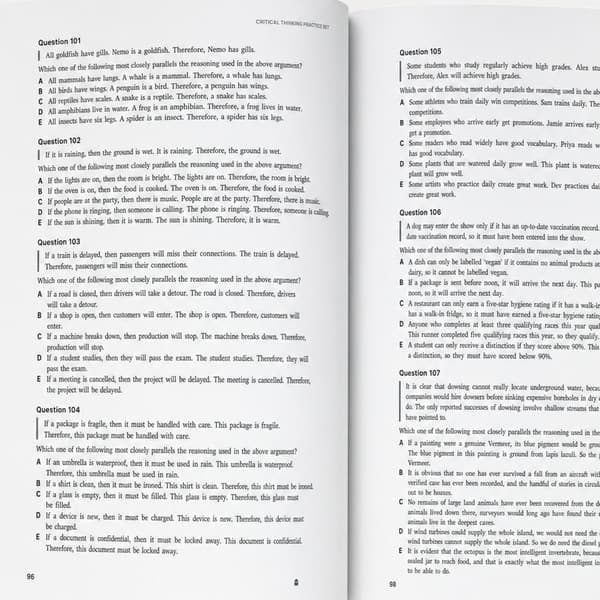
206 Critical Thinking and 206 Problem Solving questions, graded against the measured difficulty of the real papers, plus 88 more across the two mocks.
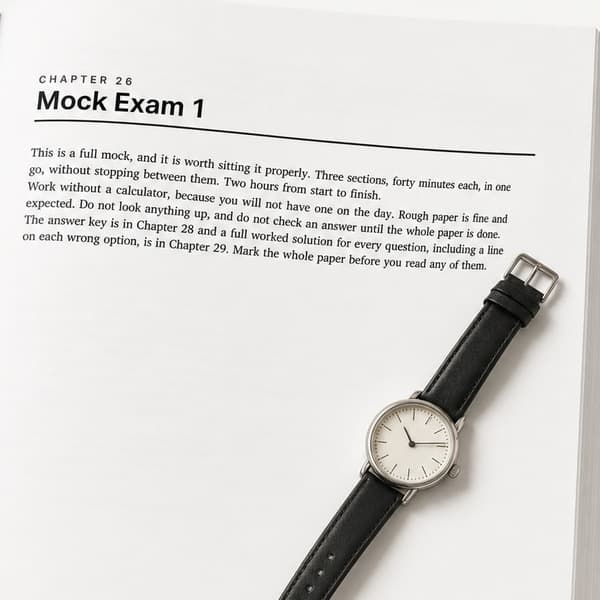
Two full mock exams, each built to the real paper's shape: 22 Critical Thinking questions, 22 Problem Solving questions and a Writing Task, in exam order.
An answer key tells you that you were wrong. A worked solution tells you where the reasoning went wrong, which is the only part that changes what you do next time.
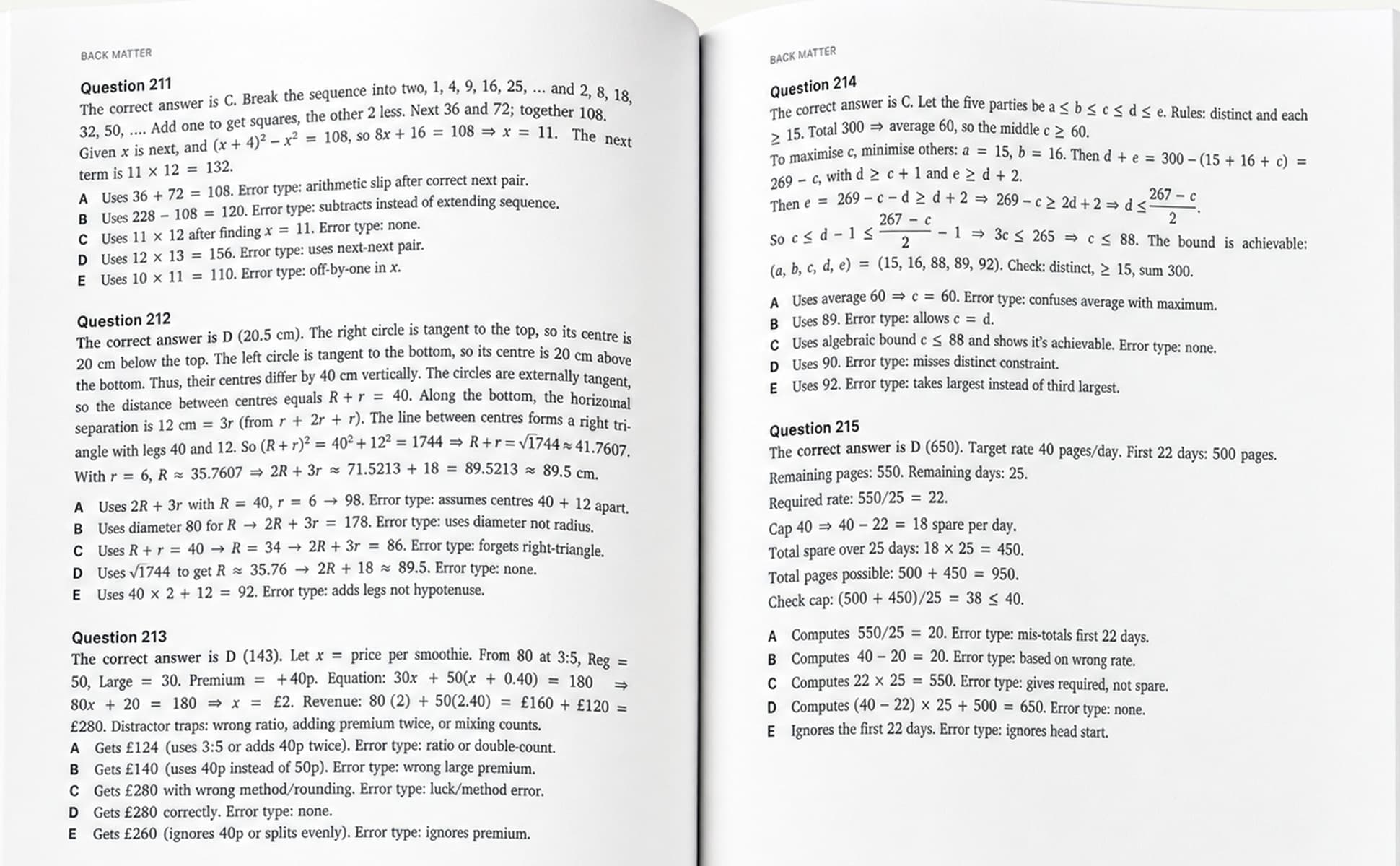
All 500 questions are worked in full, and every wrong option is explained on its own terms: what it was designed to catch, and why it looked right at the time. That is the difference between marking your practice and learning from it.
Chapter 23 answers the same Writing Task statement at three levels, marks every sentence of all three, then spells out exactly where the ground shifts between them. The commentary is organised under the six headings UAT-UK uses in its own Question Guide.
Names ideas it cannot control.
Red through most of it: four ideas named in the first paragraph, none of them controlled.
Covers all three parts, argues thinly.
Mostly amber: the structure is sound, but the counter-argument is raised and then dropped.
One narrow reading, defended properly.
Green almost throughout, with the one concession it actually pays for marked amber.
Grounded in the officially published marked essays for BMAT Section 3, the exam this task design comes from. Plus 18 practice statements in six exam-shaped sets, and four model essays shown next to the plans that produced them.
Written to be worked through from the first page to the last, and indexed well enough to dip into if you would rather not.
One chapter for each of the seven question types, each with a technique to apply under time pressure, the distractor patterns to recognise, and a worked example taken apart option by option. Closes with a 206-question practice set.
Finding Procedures, Identifying Similarity and Relevant Selection, plus a field guide to the five question formats and the organising idea behind each. Closes with its own 206-question practice set.
How to choose between three statements in under two minutes, how to plan in five, and how to produce a full answer in the time that is left. Four model essays shown next to the plans that produced them, and 18 practice statements.
Each built to the real paper's shape: 22 Critical Thinking questions, 22 Problem Solving questions and a Writing Task, in exam order, so a mock costs you the same two hours the real thing will.
Answer keys, full worked solutions for all 500 questions, a coverage table mapping every question to the skill it tests, a session tracker, and a reasoning-methods reference sheet. There is also a chapter on what the real exam screen looks like, so the interface is not one more thing you are learning on the day.
Some people think better with a book open and a pen in their hand. Some need the clock running and the real interface in front of them. Most end up wanting a bit of each, which is why these are built to sit alongside one another rather than compete.
Better when you are learning the method and want to work at your own pace.
Better when you know the method and need volume, timing and the real conditions.
There is a code inside the book that brings the price of a paid plan down for readers. You do not need it to start: the free account is free either way.
Marked as you go. The worked solution — the reasoning that actually teaches you something — is what the book gives you 500 of, and what a free account opens up here.
5 original TARA questions, written to the current spec. See how you do before you commit to anything.
The National Deck Fixings Association writes to notify members of increased warpage-related callbacks reported over the past two seasons, a period during which more installers adopted hidden edge-fixing clips instead of visible screws. At a pilot site in Yorkshire, the same three installers who fitted boards there in both seasons switched from hidden clips to torque-limited face-fixing screws, using timber from the same supplier; warpage complaints for that site fell by half. The Association recommends all members switch to torque-limited face-fixing screws as standard practice, on the basis that doing so will cut warpage-related callbacks across the membership.
Which is an underlying assumption of the argument?
TARA is sat by applicants to ten courses at Oxford and six at UCL, across the social sciences, computer science and engineering. The book covers all three modules in full: Critical Thinking, Problem Solving and the Writing Task.
If you are starting from scratch, start at chapter one. If you already know the test and want volume, the practice sets and the mocks are waiting. Parents and teachers get the same thing the candidate does — the worked solutions are written to be read by someone who has never sat the test.
No. GhostPrep is independent and is not affiliated with, endorsed by or connected to UAT-UK, Pearson VUE, the University of Oxford or UCL. Every question in the book was written for the book — none is copied from the official papers. The teaching is grounded in the two papers UAT-UK has published and in its official Question Guide, and where the public evidence runs out, the book says so rather than guessing.
No. The book is complete on its own — teaching, practice and worked solutions for all three modules. The platform adds the things paper cannot do: the clock, a replica of the Pearson VUE interface, sessions that adapt to what you keep getting wrong, and instant marking. Plenty of people use one or the other. Which suits you is a question about how you learn, not about which is better.
A large-format A4 paperback, 682 pages, with a greyscale interior. It is a big, heavy book — the format is deliberate, because a practice set laid out at exam width and a worked solution you can annotate both need the room.
Working the teaching chapters and both practice sets properly is a term's work at a sensible pace, and the two mocks are two hours each on top. It is built to be started months out, not the week before, though the chapter structure means a late start can go straight to the techniques and the mocks.
It is sold on Amazon, which handles payment, delivery and returns under its own policy. The price, the delivery estimate and the returns window are all set by Amazon rather than by us. If there is a problem with the content of the book itself, contact us directly and we will sort it.
The test as UAT-UK currently sets it: three separately timed modules (Critical Thinking, Problem Solving and the Writing Task). The mocks follow the shape of the papers published so far, question type by question type and in exam order.
Buy the book, start free on the platform, or do both. They were built to go together.